Dart Board Distance & Height — The Complete Setup Guide
Two numbers. That's all you really need: 173cm high, 237cm back. But if you want to do it properly — and avoid the mistakes that mess up your muscle memory — read on. This takes 15 minutes to set up right and you'll never have to think about it again.
- What Is the Official Dart Board Distance?
- What Is the Official Dart Board Height?
- The Diagonal Method
- Steel Tip vs Soft Tip Comparison
- How to Set Up a Dart Board — Step by Step
- What You'll Need
- Common Setup Mistakes to Avoid
- Dart Board Distance for Kids
- Wheelchair Darts Distance
- Frequently Asked Questions
What Is the Official Dart Board Distance?
The official throwing distance for steel tip darts is 237cm (7ft 9¼in). That's from the front face of the dartboard to the oche (your throwing line). This is the exact same distance used at Ally Pally, in the Premier League, and in every PDC, WDF and BDO event going.
One thing that catches people out — you measure from the face of the dartboard, not from the wall. Your board sits about 3-4cm out from the wall when it's mounted, so if you measure from the wall you'll be standing too close. It's a small difference but it adds up over thousands of throws.
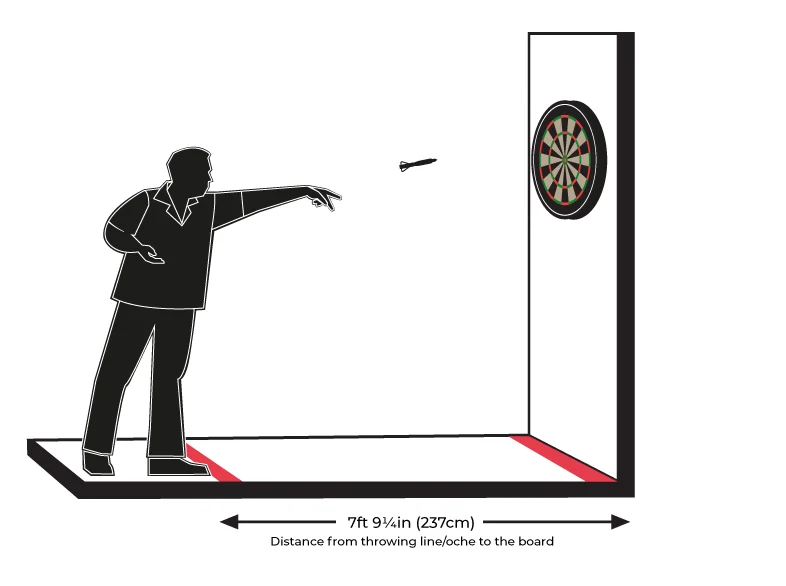 Always measure from the front face of the board — not the wall behind it.
If you're using soft tip darts on an electronic board, the distance is slightly longer at 244cm (8ft). Soft tip darts are lighter, so the extra distance evens things out.
What Is the Official Dart Board Height?
The centre of the bullseye goes at 173cm (5ft 8in) from the floor. That's it. Not the top of the board, not the bracket, not the number 20 — the dead centre of the bull.
This is the same for both steel tip and soft tip darts and it's consistent across every darts organisation worldwide. Doesn't matter if you're in a pub in London or a tournament in Tokyo — 173cm to the bull.
The most common mistake people make is measuring to the top of the board. Don't do that. The top of a standard board sits at roughly 190cm — that's about 17cm higher than the bullseye. If you measure to the top, everything is off.
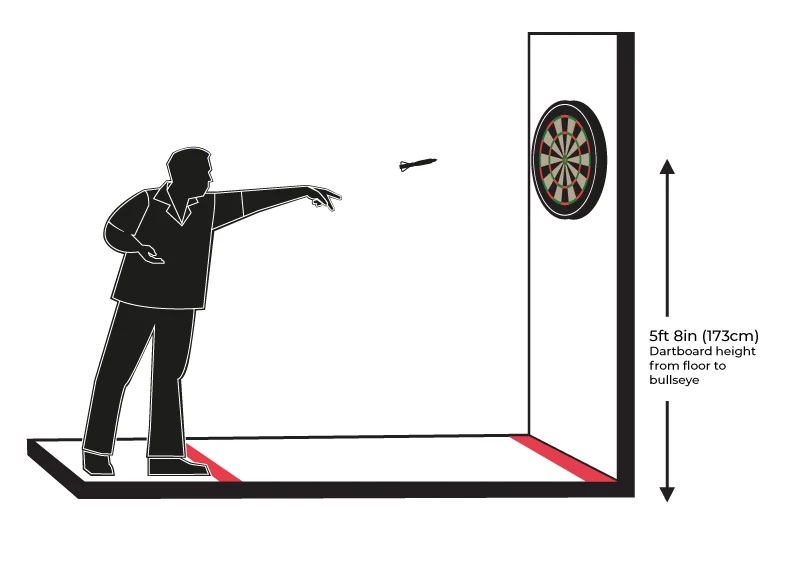 Measure to the dead centre of the bullseye. Not the top. Not the bracket. The bull.
If your floor is uneven or you've got thick carpet, use a spirit level to make sure your measurement is accurate. Even being 1-2cm off will affect your throw over time. You'll build muscle memory for the wrong height and wonder why you can't hit the same shots anywhere else.
The Diagonal Method — The Easiest Way to Check Your Setup
This is the trick that most people don't know about. Instead of measuring height and distance separately and hoping they're both right, you can check the whole setup with one single measurement — the diagonal from the bullseye to the oche.
It works because of basic maths — the height (173cm) and distance (237cm) form a right-angled triangle. The diagonal (293.4cm) is the hypotenuse. If the diagonal is right, both the height and the distance must be right too. One measurement, two answers.
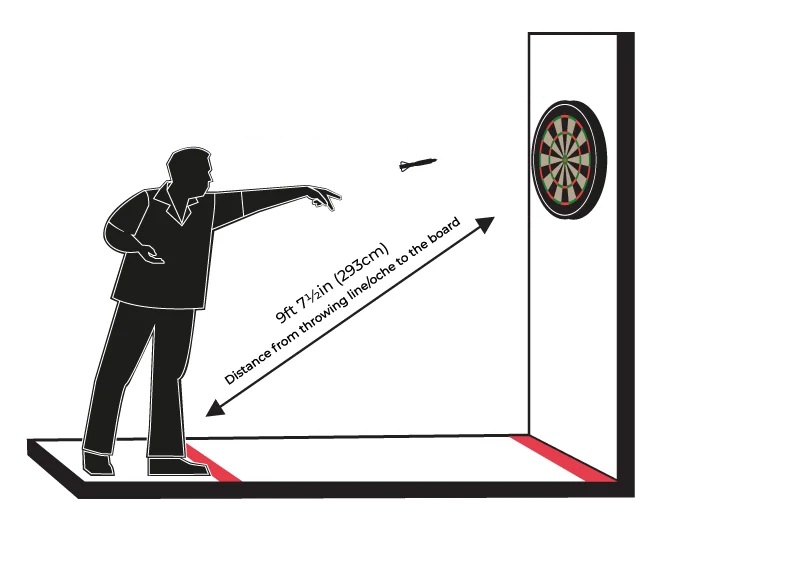 One measurement checks everything. If the diagonal is 293.4cm, you're spot on.
How to Use the Diagonal Method
- Get a piece of string and attach one end to the centre of the bullseye
- Measure the string to 293.4cm (9ft 7½in)
- Pull the string taut to the floor at an angle
- Where the string touches the floor — that's where your oche goes
If you've already set everything up, just measure the diagonal as a final check. If it comes out at 293.4cm, you've nailed it. If it's off, something needs adjusting.
Steel Tip vs Soft Tip — Distance Comparison
Most of the measurements are identical. There's only one difference, and it's the throwing distance:
| Measurement | Steel Tip | Soft Tip |
|---|---|---|
| Throwing Distance | 237cm (7ft 9¼in) | 244cm (8ft) |
| Board Height | 173cm (5ft 8in) | 173cm (5ft 8in) |
| Diagonal | 293.4cm (9ft 7½in) | 299.4cm (9ft 10in) |
| Board Type | Bristle / Sisal | Electronic / Plastic |
If you're setting up at home for regular play, go with the steel tip measurements. These are the same ones used in every PDC tournament you see on TV — the Premier League, the World Championship at Ally Pally, the lot. Even if you're just a casual player, practising at the right distance means your game transfers when you play at the pub or in a league.
How to Set Up a Dart Board at Home — Step by Step
Right, let's get this thing on the wall. The whole process takes about 15-20 minutes. You'll need a tape measure, a pencil, a drill and about 10 minutes of patience.
Pick Your Wall
Find a solid wall with enough room around it. You want at least 60cm of clearance either side of the board (your darts will miss — it happens) and about 3 metres of open space in front for the throwing area. Stay away from windows, doorways and anywhere people walk past. Nobody wants a dart in the shoulder.
Mark the Height
Measure 173cm (5ft 8in) up from the floor and make a small pencil mark on the wall. That's where the centre of the bullseye is going to sit. Use a tape measure and ideally a spirit level to make sure you're accurate. If your floor isn't perfectly level, measure from the most level spot.
Fix the Bracket
Most dartboards come with a mounting bracket. Fix it to the wall at your pencil mark using the right fixings for your wall type. Plasterboard? Use heavy-duty wall anchors or toggle bolts — normal screws will pull out. Brick? Standard rawl plugs and screws will do the job.
Hang the Board
Place the dartboard onto the bracket. Make sure the number 20 is at the top — that's the 12 o'clock position. It should sit flush against the bracket and not wobble. Give the bullseye a quick measure to double-check it's at 173cm. If it's off, adjust the bracket.
Measure the Throwing Distance
From the front face of the dartboard (not the wall), measure 237cm (7ft 9¼in) along the floor. Mark this point. This is where your oche goes. Remember — from the board face, not the wall. The board sticks out 3-4cm from the wall.
Set Up the Oche
Put your throwing line at the mark. You've got a few options here: a dart mat with the oche line printed on it (easiest — just roll it out), a raised oche strip you stick to the floor, or a bit of tape if you're keeping it simple. A proper dart mat also protects your floor from dropped darts.
Check It with the Diagonal
Last step — the sanity check. Measure from the centre of the bullseye diagonally down to the front of the oche. It should be 293.4cm (9ft 7½in). If it matches, you're golden. If it doesn't, something's off and you need to re-measure. This catches any errors in one go.
What You'll Need
Here's everything you need to get set up properly. You probably already have a tape measure and a drill — the rest depends on how serious you want your setup to look:
Winmau Blade 6 Dartboard
The one the pros use. Ultra-thin wiring, self-healing sisal, used in every PDC event. It's the standard for a reason. Full review in our Best Dart Boards 2026 guide.
Winmau Fixing Kit / Mounting Bracket
Makes hanging the board dead simple. Comes with all the fixings you need. Much more secure than the basic bracket that comes in most dartboard boxes.
Dartboard Surround
Your wall will thank you for this. Catches all the darts that miss the board — and when you're starting out, that's a lot of darts. Saves you a fortune in replastering. About £10-20.
Dart Mat with Oche Line
Roll it out and your oche is already marked at the right distance. Also protects your floor from darts that bounce out or fall short. Heavy-duty rubber backing stops it sliding around.
Tape Measure (3m+)
You'll need one that goes to at least 3 metres for the diagonal check. Any standard tape measure will do — you've probably got one in a drawer somewhere.
* Affiliate links — we earn a small commission at no extra cost to you.
Common Setup Mistakes to Avoid
These are the ones that trip people up every time. Get these right and you won't have to redo anything:
Measuring from the wall instead of the board face
This is the most common one. Your board sits 3-4cm out from the wall when it's mounted. If you measure 237cm from the wall, you're actually standing about 233cm from the board. Measure from the front face of the board. Always.
Measuring height to the top of the board
The 173cm measurement is to the centre of the bullseye, not the top of the board. The top of a standard board sits at roughly 190cm. If you hang it with the top at 173cm, your bullseye will be about 17cm too low and everything will feel wrong.
Skipping the diagonal check
The diagonal measurement (293.4cm) catches mistakes in both height and distance with one check. It takes 30 seconds. Do it. If the diagonal is right, everything else is right.
Number 20 not at the top
The 20 goes at 12 o'clock. Every time. This is the standard orientation used in every professional event and every pub in the country. If your 20 is anywhere else, rotate the board.
Not accounting for uneven floors
Thick carpet, sloping garage floors, wonky floorboards — they all throw your measurements off. If your floor isn't level, use a spirit level and measure from the most level point you can find. It matters more than you'd think.
Dart Board Distance for Kids
There aren't any official junior measurements, but these are the commonly used guidelines based on age. The idea is simple — start closer and lower, then gradually move back to the full distance as they grow and improve:
| Age Group | Recommended Distance | Board Height |
|---|---|---|
| Under 8 | 150cm (4ft 11in) | 137cm (4ft 6in) |
| 8 – 11 | 190cm (6ft 3in) | 155cm (5ft 1in) |
| 12 – 14 | 220cm (7ft 3in) | 173cm (5ft 8in) |
| 15+ | 237cm (7ft 9¼in) | 173cm (5ft 8in) |
The most important thing is that they can actually reach the board and hit it consistently. If they're throwing as hard as they can and still bouncing darts off the floor, they're too far away. Move them closer. They'll have more fun, stay interested, and naturally want to step back as they improve. Also — use soft tip darts and an electronic board for younger kids. Much safer.
Wheelchair Darts Distance
Wheelchair darts uses adjusted measurements so the board sits at a comfortable height for seated players. The throwing distance stays the same — only the board height changes:
| Measurement | Standard | Wheelchair |
|---|---|---|
| Board Height | 173cm (5ft 8in) | 137cm (4ft 6in) |
| Throwing Distance | 237cm (7ft 9¼in) | 237cm (7ft 9¼in) |
| Diagonal | 293.4cm (9ft 7½in) | 274cm (8ft 11¾in) |
The board drops to 137cm (4ft 6in) so the bullseye sits at a comfortable eye-level height for seated players. The throwing distance stays at 237cm — same as standing darts. These are the official measurements used in PDC wheelchair darts events.
Frequently Asked Questions
How far do you stand from a dart board?
237cm (7ft 9¼in) for steel tip darts. 244cm (8ft) for soft tip. Measured from the front face of the dartboard to the front of the oche. Not from the wall — the board sticks out a few cm from the wall when it's mounted.
How high should a dart board be from the floor?
173cm (5ft 8in) from the floor to the centre of the bullseye. Same for steel tip and soft tip. Same everywhere in the world. Measure to the bull, not the top of the board.
What is the oche in darts?
The oche (pronounced "ockey") is the throwing line. You stand behind it when you throw your darts. It goes 237cm from the face of the board for steel tip darts. You can use a raised strip, a dart mat with the line already on it, or just a bit of tape on the floor.
Can I set up a dartboard on a plasterboard wall?
Yes, but don't just use normal screws — they'll pull straight out with the weight of the board. Use plasterboard anchors or toggle bolts. A dartboard weighs about 5kg so it needs decent fixings. A proper mounting bracket helps spread the load. If you're not confident with DIY, get someone handy to help.
Is the distance the same for steel tip and soft tip darts?
No. Steel tip is 237cm (7ft 9¼in) and soft tip is 244cm (8ft) — about 7cm further back. The board height stays the same at 173cm for both.
Do I measure from the wall or the board?
From the front face of the board. Always. The board sits 3-4cm away from the wall when it's mounted, so measuring from the wall gives you the wrong distance. It's a small difference but it matters.
Related Guides
🎯 Get Your Daily Darts Fix
Visit Darts Daily for daily player profiles, trivia, stats, news and upcoming events from the world of professional darts.
Visit Darts Daily →