How to Score Darts — The Complete Beginner's Guide
Darts scoring looks complicated until someone explains it properly. Then it's dead simple. Singles are face value, doubles are double, trebles are triple. The tricky bit is knowing how to finish — and that's where the checkout chart comes in. This guide covers everything from your first throw to finishing like a pro.
Understanding the Dartboard — What Each Bit Is Worth
A standard dartboard has 20 numbered segments, each worth its face value. But the board also has two thin rings that multiply your score — and this is where it gets interesting:
Double Ring — The thin outer ring right at the edge. Worth 2× the number. You need to hit these to finish a game.
Triple Ring — The thin inner ring about halfway out. Worth 3× the number. This is the highest-scoring zone on the board.
Outer Bullseye — The green ring in the centre. Worth 25 points.
Inner Bullseye — The small red dot in the dead centre. Worth 50 points and counts as a double.
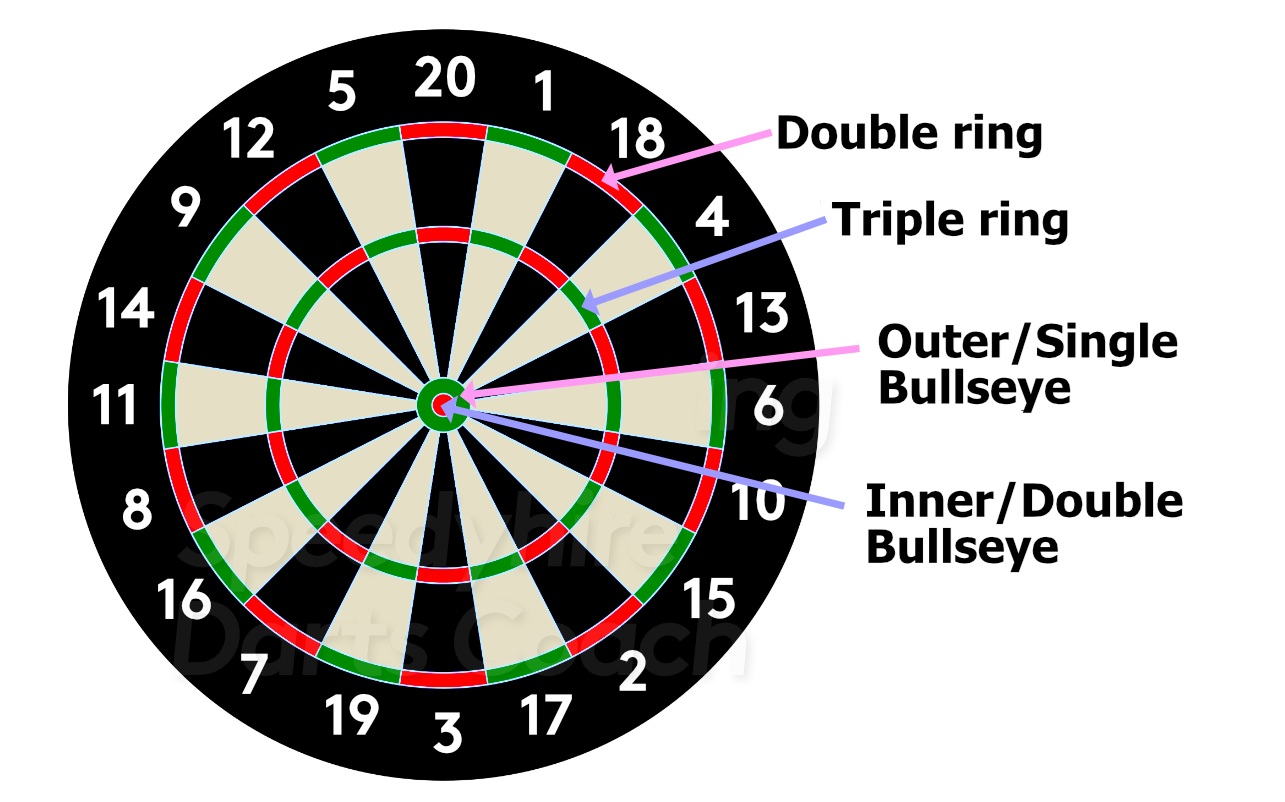 Singles are the big areas. Doubles are the thin outer ring. Triples are the thin inner ring. Bullseye is the centre.
The highest scoring spot on the board isn't the bullseye — it's treble 20, worth 60 points. The bullseye is only worth 50. That's why every pro aims at the top of the board, not the middle. The bullseye looks impressive but treble 20 scores more.
The maximum score from three darts is 180 — three treble 20s. 60 + 60 + 60. When this happens on TV, the caller screams "ONE HUNDRED AND EIGHTY!" and the crowd goes absolutely mental. It's the most iconic moment in darts.
Scoring Table — Every Segment at a Glance
Here's what every segment on the board is worth. Bookmark this if you're just starting out — you'll want it handy:
| Number | Single | Double | Triple |
|---|---|---|---|
| 1 | 1 | 2 | 3 |
| 2 | 2 | 4 | 6 |
| 3 | 3 | 6 | 9 |
| 4 | 4 | 8 | 12 |
| 5 | 5 | 10 | 15 |
| 6 | 6 | 12 | 18 |
| 7 | 7 | 14 | 21 |
| 8 | 8 | 16 | 24 |
| 9 | 9 | 18 | 27 |
| 10 | 10 | 20 | 30 |
| 11 | 11 | 22 | 33 |
| 12 | 12 | 24 | 36 |
| 13 | 13 | 26 | 39 |
| 14 | 14 | 28 | 42 |
| 15 | 15 | 30 | 45 |
| 16 | 16 | 32 | 48 |
| 17 | 17 | 34 | 51 |
| 18 | 18 | 36 | 54 |
| 19 | 19 | 38 | 57 |
| 20 | 20 | 40 | 60 |
| Outer Bull | 25 | — | — |
| Inner Bull | — | 50 | — |
How to Play 501 — The Game Everyone Watches
501 is the standard game. It's what they play at every PDC event, every league night, every pub match. If you've seen darts on TV, you've watched 501. Here's how the scoring works:
The Rules
- Both players start on 501
- Each turn, throw 3 darts
- Add up your three darts and subtract that from your remaining score
- Keep going until you reach exactly zero
- Your final dart must hit a double — this is called "double out"
Example Game — What a Perfect 9-Darter Looks Like
Let's walk through the most famous sequence in darts — the perfect game:
| Turn | Dart 1 | Dart 2 | Dart 3 | Turn Score | Remaining |
|---|---|---|---|---|---|
| 1 | T20 (60) | T20 (60) | T20 (60) | 180 | 321 |
| 2 | T20 (60) | T19 (57) | T18 (54) | 171 | 150 |
| 3 | T20 (60) | T18 (54) | D18 (36) | 150 | 0 ✅ |
That's a nine-darter — the perfect game. 501 in just 9 darts. It's the darts equivalent of a 147 in snooker or a hole-in-one in golf. Incredibly rare, even for professionals. When it happens on stage the roof comes off.
What Is a Bust?
A bust is when you mess up your finish. It happens in three ways:
- Your score drops below zero — you've overshot
- Your score lands on exactly 1 — impossible to finish because the lowest double is 2 (D1)
- Your score hits zero but your last dart wasn't a double — so close, yet so far
When you bust, your whole turn is scrubbed. Score goes back to what it was before you threw. Any remaining darts in that turn? Forfeited. Walk back to the oche and try again next turn.
Always try to leave yourself on an even number. Even numbers can always be finished with a double. If you leave an odd number, you need to hit a single first to get back to even — that's an extra dart wasted. Plan your scoring throws so you land on something you can actually finish.
How to Play 301
301 is just 501 with a shorter starting score. Same rules, same double-out finish, just quicker. It's popular in pubs when you want a faster game without changing the format.
Double out: Yes — same as 501
Double in: Optional — some pubs require it, pros don't
Game length: Shorter — typically 6-12 darts
What's "Double In"?
Some pub versions of 301 make you hit a double before you can start scoring. Until you land in a double, nothing counts. This is called "double in" and it makes the start of each leg a scramble. It's not used in professional play — only double out is standard — but it's worth knowing because you'll hear "are we doing double in?" a lot in pubs.
When to Play 301 vs 501
- 301 — quick games, practice sessions, warming up your doubles
- 501 — competitive play, league matches, anything serious
- 701 or 1001 — doubles and team games where you want a longer format
What Is a Checkout in Darts?
A checkout is how you finish the game — reaching exactly zero with your last dart landing in a double. Knowing which combination of darts gets you there is half the battle. You don't need to memorise every checkout right away, but knowing the common ones will save you standing at the oche looking confused.
Lowest checkout: 2 (D1)
Most common finish: D20 (40) — also called "tops"
Bullseye counts as: A double (worth 50)
Common Checkouts You Should Know
These are the ones that come up all the time. Learn these first and you'll cover most finishing situations:
| Score Left | Checkout | Darts Needed |
|---|---|---|
| 40 | D20 | 1 dart |
| 36 | D18 | 1 dart |
| 32 | D16 | 1 dart |
| 50 | Bull | 1 dart |
| 80 | T20 → D10 | 2 darts |
| 100 | T20 → D20 | 2 darts |
| 170 | T20 → T20 → Bull | 3 darts |
Bogey Numbers — Scores You Can't Finish
Some scores between 100 and 170 are impossible to check out with three darts. These are called bogey numbers and smart players try to avoid leaving themselves on one:
Darts Checkout Chart (2–170)
This is the page you'll keep coming back to. Bookmark it. Screenshot it. Stick it on your wall next to the board. These are the recommended checkouts for every finishable score in darts:
3-Dart Checkouts (101–170)
These are the big finishes. Three darts, all need to count. When someone hits a 170 checkout on TV, the place erupts.
| Score | Checkout |
|---|---|
| 170 | T20 → T20 → Bull |
| 167 | T20 → T19 → Bull |
| 164 | T20 → T18 → Bull |
| 161 | T20 → T17 → Bull |
| 160 | T20 → T20 → D20 |
| 158 | T20 → T20 → D19 |
| 157 | T20 → T19 → D20 |
| 156 | T20 → T20 → D18 |
| 155 | T20 → T19 → D19 |
| 154 | T20 → T18 → D20 |
| 153 | T20 → T19 → D18 |
| 152 | T20 → T20 → D16 |
| 151 | T20 → T17 → D20 |
| 150 | T20 → T18 → D18 |
| 149 | T20 → T19 → D16 |
| 148 | T20 → T16 → D20 |
| 147 | T20 → T17 → D18 |
| 146 | T20 → T18 → D16 |
| 145 | T20 → T15 → D20 |
| 144 | T20 → T20 → D12 |
| 143 | T20 → T17 → D16 |
| 142 | T20 → T14 → D20 |
| 141 | T20 → T19 → D12 |
| 140 | T20 → T20 → D10 |
| 139 | T20 → T13 → D20 |
| 138 | T20 → T18 → D12 |
| 137 | T20 → T19 → D10 |
| 136 | T20 → T20 → D8 |
| 135 | T20 → T17 → D12 |
| 134 | T20 → T14 → D16 |
| 133 | T20 → T19 → D8 |
| 132 | T20 → T16 → D12 |
| 131 | T20 → T13 → D16 |
| 130 | T20 → T18 → D8 |
| 129 | T19 → T16 → D12 |
| 128 | T18 → T14 → D16 |
| 127 | T20 → T17 → D8 |
| 126 | T19 → T19 → D6 |
| 125 | T20 → T15 → D10 |
| 124 | T20 → T16 → D8 |
| 123 | T19 → T16 → D9 |
| 122 | T18 → T18 → D7 |
| 121 | T20 → T11 → D14 |
| 120 | T20 → S20 → D20 |
| 119 | T19 → T12 → D13 |
| 118 | T20 → S18 → D20 |
| 117 | T20 → S17 → D20 |
| 116 | T20 → S16 → D20 |
| 115 | T20 → S15 → D20 |
| 114 | T20 → S14 → D20 |
| 113 | T20 → S13 → D20 |
| 112 | T20 → T12 → D8 |
| 111 | T20 → S11 → D20 |
| 110 | T20 → Bull |
| 109 | T20 → S9 → D20 |
| 108 | T20 → S16 → D16 |
| 107 | T19 → Bull |
| 106 | T20 → S6 → D20 |
| 105 | T20 → S5 → D20 |
| 104 | T18 → Bull |
| 103 | T20 → S3 → D20 |
| 102 | T20 → S2 → D20 |
| 101 | T17 → Bull |
2-Dart Checkouts (61–100)
These come up constantly. If you can nail these reliably, you'll win a lot more legs:
| Score | Checkout |
|---|---|
| 100 | T20 → D20 |
| 99 | T19 → D21 |
| 98 | T20 → D19 |
| 97 | T19 → D20 |
| 96 | T20 → D18 |
| 95 | T19 → D19 |
| 94 | T18 → D20 |
| 93 | T19 → D18 |
| 92 | T20 → D16 |
| 91 | T17 → D20 |
| 90 | T18 → D18 |
| 89 | T19 → D16 |
| 88 | T16 → D20 |
| 87 | T17 → D18 |
| 86 | T18 → D16 |
| 85 | T15 → D20 |
| 84 | T20 → D12 |
| 83 | T17 → D16 |
| 82 | T14 → D20 |
| 81 | T19 → D12 |
| 80 | T20 → D10 |
| 79 | T13 → D20 |
| 78 | T18 → D12 |
| 77 | T19 → D10 |
| 76 | T20 → D8 |
| 75 | T17 → D12 |
| 74 | T14 → D16 |
| 73 | T19 → D8 |
| 72 | T16 → D12 |
| 71 | T13 → D16 |
| 70 | T18 → D8 |
| 69 | T19 → D6 |
| 68 | T20 → D4 |
| 67 | T17 → D8 |
| 66 | T10 → D18 |
| 65 | T19 → D4 |
| 64 | T16 → D8 |
| 63 | T13 → D12 |
| 62 | T10 → D16 |
| 61 | T15 → D8 |
1-Dart Checkouts (2–40 even numbers + 50)
The dream scenario — one dart, game over. These are all just doubles:
| Score | Checkout |
|---|---|
| 50 | Bull |
| 40 | D20 |
| 38 | D19 |
| 36 | D18 |
| 34 | D17 |
| 32 | D16 |
| 30 | D15 |
| 28 | D14 |
| 26 | D13 |
| 24 | D12 |
| 22 | D11 |
| 20 | D10 |
| 18 | D9 |
| 16 | D8 |
| 14 | D7 |
| 12 | D6 |
| 10 | D5 |
| 8 | D4 |
| 6 | D3 |
| 4 | D2 |
| 2 | D1 |
32 (D16) is the favourite finishing number for a reason. If you miss D16 and hit single 16, you're left on 16 — which is D8. Miss that and hit single 8? You're on 8 — D4. Miss that? 4 — D2. Each miss gives you another shot at a double. It's the most forgiving number on the board. Always try to set yourself up on 32 if you can.
How to Score Cricket
Cricket is completely different to 501. Instead of counting down, you're trying to "close" specific numbers while racking up points. It's huge in the US and it's the second most popular darts game worldwide. The scoring works like this:
Players: 2 players or 2 teams
Objective: Close all numbers and have the most points
Closing a number: Hit it 3 times (single = 1, double = 2, treble = 3)
How It Works
- Take turns throwing 3 darts at numbers 15–20 and the bullseye. Everything else on the board is irrelevant
- Hit each number 3 times to close it — a single counts as 1 mark, double as 2, treble as 3. One treble closes a number instantly
- Once you've closed a number, extra hits on it score you points — but only while your opponent's version is still open
- Once both players close a number, it's dead. Nobody can score on it any more
- First to close all 7 numbers wins — but only if you've got equal or more points. If you're behind, you need to keep scoring
Cricket Strategy
- Start with 20s — highest value number, scores the most points once closed
- Shut down their scoring — if your opponent has closed something you haven't, close it fast to stop them racking up points
- Don't just race to close — build a points cushion. Closing everything means nothing if you're behind on points
- Trebles are everything — one treble closes a number in one dart. Two trebles on 20 closes it and scores 20 points on top
Other Popular Darts Games
501 and Cricket get the most attention but these are great for mixing things up, especially in groups:
Around the Clock
Hit 1 through 20 in order, then finish on the bullseye. First one done wins. Doubles and trebles count as hitting that number. The best warm-up game going — it teaches you where every number is on the board. Full rules in our Darts Rules guide.
Killer
Everyone throws with their weak hand to get a random number. Then you try to hit other people's doubles to knock their lives off while protecting your own. Last one standing wins. Gets properly dramatic with a few drinks involved. Best with 3+ players.
Shanghai
Each round everyone aims at a specific number — round 1 is 1s, round 2 is 2s, and so on. Score as much as you can on that number. But if you hit the single, double AND treble of the same number in one turn? That's a Shanghai — instant win, game over, no arguments.
Halve It
Targets are set for each round (e.g. 20s, 19s, any double, any treble, bull). Hit the target? Score points. Miss all three darts? Your total gets halved. One bad round and you're in serious trouble. Brutal but brilliant. Highest score after all rounds wins.
How to Keep Score — Pick Your Method
There are a few ways to track scores. Some are old school, some are modern. All work fine — it's just about what suits you:
Chalkboard / Whiteboard
The traditional way. Write both scores at the top, subtract each turn. There's something satisfying about wiping the chalk and writing the new number. Gives your setup a proper pub feel.
Scoring Apps
Free apps like Darts Scoreboard, My Dart Training and DartCounter do all the maths for you, suggest checkouts, and track your averages over time. Genuinely useful for improving. Available on iOS and Android.
Electronic Dartboard
Electronic boards handle scoring automatically — just throw and the board does the rest. Great if maths isn't your thing. Most support 501, 301, Cricket and loads of other games. See our Best Electronic Dart Boards guide for recommendations.
* Affiliate links — we earn a small commission at no extra cost to you.
Darts Terminology — The Words You'll Hear
Watch any darts match on TV and you'll hear half of these. Here's what they all mean:
| Term | Meaning |
|---|---|
| Checkout | Finishing the game by reaching exactly zero on a double |
| Bust | Going below zero or finishing without a double — your turn is wiped |
| Ton | Any score of 100+ in a single turn. "He's hit a ton" = 100 or more |
| Ton-eighty (180) | Three treble 20s. The maximum. The one that makes the crowd go mental |
| Double in | Needing to hit a double before scoring starts (some 301 pub rules) |
| Double out | Must finish on a double — standard in all competitive darts |
| Oche | The throwing line. Pronounced "ockey". Stand behind it |
| Leg | One game of 501 or 301. A match is made up of multiple legs |
| Set | A group of legs. Win enough legs and you win the set |
| Nine-darter | The perfect game — 501 finished in 9 darts. Incredibly rare |
| Madhouse | Double 1. The smallest, most frustrating double on the board |
| Shanghai | Hitting single, double and treble of the same number in one turn |
| Bogey number | A score with no possible three-dart checkout (169, 168, etc.) |
| Tops | Double 20. The most common finishing target. "He's going for tops" |
| Bed and breakfast | Scoring 26 — single 20, single 5, single 1. The classic miss pattern when aiming at 20 |
| Mugs away | Loser of the last leg throws first in the next one. Common pub rule |
| Robin Hood | When a dart lands in the flight or shaft of a dart already in the board. Looks cool, scores nothing |
Scoring Tips for Beginners
A few things that'll help you score better and avoid common mistakes:
Aim for Treble 20, Not the Bullseye
Everyone wants to hit the bull when they start out. But treble 20 is worth 60 — the bullseye is only 50. The pros aim at treble 20 for scoring and only go for the bull when they need it for a checkout. Train yourself to aim up top from the start.
Learn 5 Checkouts First
You don't need the whole chart memorised on day one. Start with these five: 40 (D20), 32 (D16), 36 (D18), 24 (D12) and 16 (D8). These cover most of the situations you'll find yourself in as a beginner. Add more over time.
Always Leave an Even Number
When you're getting close to a finish, plan your throws so you end up on an even number. Even numbers can always be hit with a double. Odd numbers need a single first to get back to even — that's wasting a dart.
Practice Doubles More Than Anything
Doubles win games. Full stop. Spend at least 30% of your practice time throwing at the double ring. D20 and D16 are the most important ones. If you can hit doubles consistently, you'll beat players who outscore you in the middle of the leg.
Don't Panic on Big Numbers
If you're on 120, you don't have to finish it in one turn. Hit T20 (60) to leave 60, then next turn go S20 + D20. Breaking it into manageable chunks is smarter than trying to be a hero and busting. Steady scoring beats wild throwing every time.
Use a Scoring App
Let the app do the maths so you can focus on throwing. Most apps suggest checkouts too, so you'll learn the finishes naturally over time. They also track your averages — watching that number go up is genuinely motivating.
Frequently Asked Questions
What is the highest score you can get with 3 darts?
180. Three treble 20s — 60 + 60 + 60. It's called a "maximum" or "ton-eighty" and it's the moment everyone in the venue loses their mind. The most celebrated score in darts.
What is the highest checkout in darts?
170 — treble 20, treble 20, bullseye. It's the highest you can finish on because the bullseye (50) counts as a double. Very few people ever hit one, even pros. When it happens on TV, it's a moment.
Do you have to finish on a double?
Yes. In standard 501 and 301, your last dart has to land in a double or the inner bull (which counts as double 25). This is called "double out" and it's the rule in every professional tournament. No double, no finish.
What happens if you go below zero?
That's a bust. Your score snaps back to what it was before that turn and any remaining darts are forfeited. If you've got 32 left and you accidentally score 33? Back to 32. Painful but them's the rules.
Is the bullseye worth 50 points?
The inner bull (little red circle) is worth 50 and counts as a double. The outer bull (green ring around it) is worth 25 and counts as a single. When people say "bullseye" they usually mean the inner one.
What scores have no checkout?
The bogey numbers: 169, 168, 166, 165, 163, 162 and 159. These can't be finished with three darts. Anything above 170 can't be checked out either. If you're on one of these, you need to score enough to drop below it without landing on another bogey. Good players plan ahead to avoid these.
How do you play Cricket in darts?
Numbers 15 through 20 and the bullseye. Hit each one 3 times to close it — singles = 1 mark, doubles = 2, trebles = 3. Once you've closed a number, extra hits score you points until your opponent closes it too. First to close everything with equal or more points wins. More detail in our Darts Rules guide.
What does "mugs away" mean?
The loser throws first in the next leg. It's a pub rule that gives the losing player a slight edge by letting them throw before their opponent. You'll hear it in every pub that has a dartboard.
Related Guides
🎯 Get Your Daily Darts Fix
Visit Darts Daily for daily player profiles, trivia, stats, news and upcoming events from the world of professional darts.
Visit Darts Daily →